A Lower Bottle Price Can Arrive with a Higher Delivered Cost
Allocate the delivery charge before deciding which small supplier order is cheaper.
Published 2026-10-21 · Fragrentis editorial team2 min read
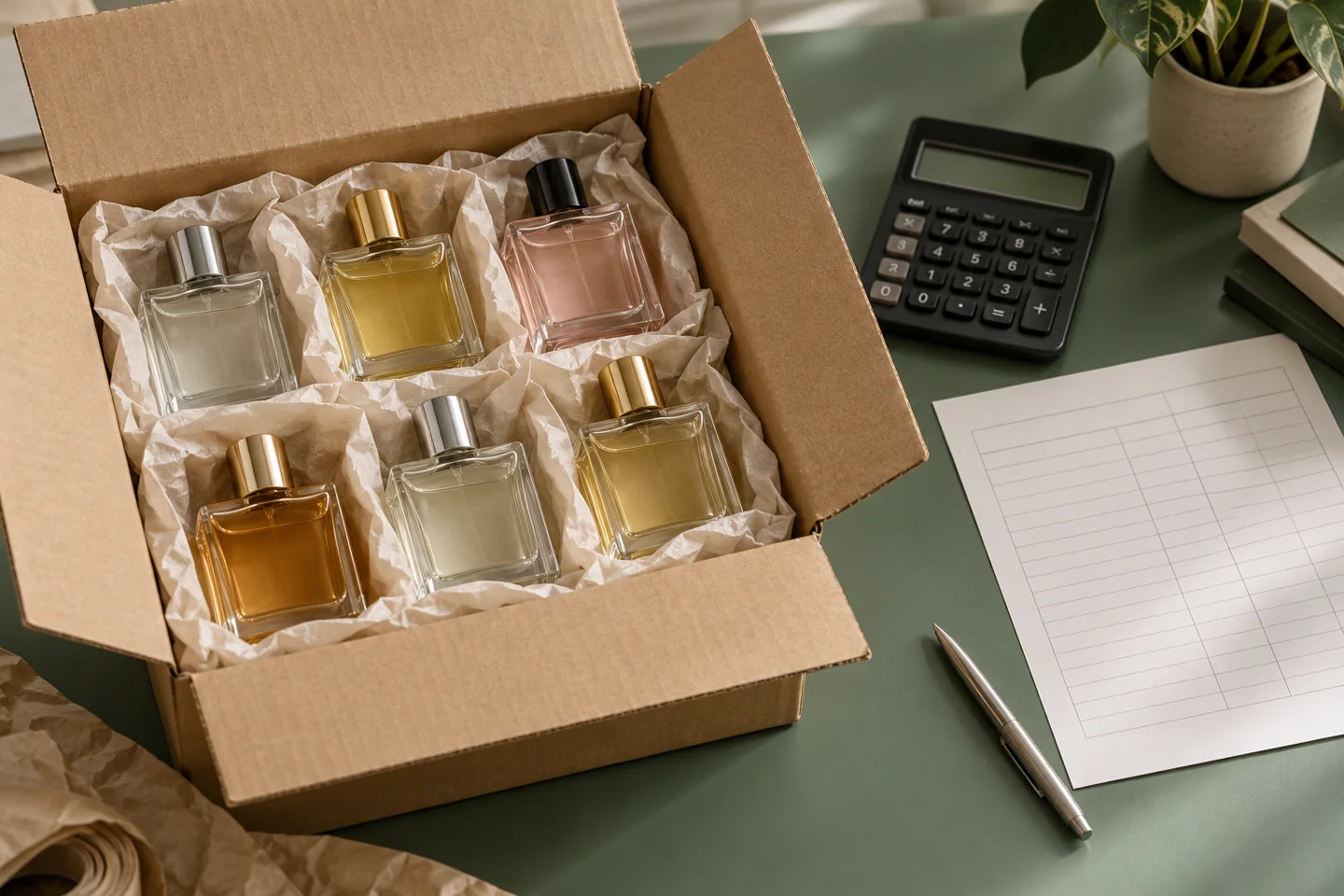
IFF’s September 30, 2026 AQUASCENT announcement describes a water-based fragrance carrier that can be supplied as a concentrate, with water added during final production. The company presents reduced shipping volume and weight as an opportunity. That is an upstream technology claim, not a measured freight saving for a shop buying finished bottles.
The useful purchasing question travels further than the technology: what, exactly, is included in the delivered quote?
Bring the delivery line into the comparison
For a simple teaching calculation, define delivered cost per unit as the purchase cost plus the specified delivery charge, divided by the units received. This deliberately narrow example excludes taxes, duties, currency conversion and other fees; it is not an import-cost calculation or accounting policy.
Example delivered cost per unit = (bottle purchase total + quoted delivery) ÷ units.
Here is an invented US-dollar comparison for finished products. Offer A is 12 bottles at $10 each, plus $36 delivery. The specified total is $156, or $13 per bottle. Offer B is 12 bottles at $11 each, plus $12 delivery. That total is $144, or $12 per bottle.
The lower bottle-price offer costs $12 more for this order under these assumptions. Before comparing, confirm that the products, quantities, destination and included services are genuinely comparable. Do not treat two differently specified offers as equivalent because the arithmetic is tidy.
Ask what changes with quantity
A fixed delivery charge spread across more units may reduce the per-unit allocation. It also commits more cash to stock. Ask for the actual next quantity quote rather than assuming the freight rate scales evenly. A carrier, case size or service change can alter the result.
Receiving fewer saleable units than expected changes the economic picture too. Record discrepancies separately and resolve them with the supplier. Do not quietly divide by the ordered quantity when the usable quantity differs.
Keep opportunity separate from certainty
New carrier technologies may create useful options for manufacturers and their customers. A retailer still needs product-specific evidence before claiming lower freight, easier handling or better performance. Do not dilute a finished perfume to imitate an upstream concentrate system.
The positive case is a clearly specified order that leaves room for contribution and sells within a realistic period. It depends on delivery terms, demand and execution. A quote comparison should make those conditions visible before you commit cash, even when the headline bottle price looks attractive.
Sources and scope
- IFF: AQUASCENT water-based fragrance technology. Supplier announcement September 30, 2026. Concentrate transport description is a company claim, not a measured saving for a retailer. Accessed October 21, 2026.
A Fragrentis editorial publication. Editorial policy and disclosure.